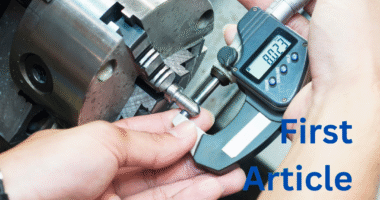

A First Article Inspection (FAI) is a critical quality control process used to verify that a new or modified product meets all design and engineering specifications before full-scale production begins. Common in industries like aerospace, automotive, and electronics, FAI helps manufacturers detect errors early, avoid costly rework, and ensure compliance with standards like AS9102.
Here’s a step-by-step guide on how to properly conduct an FAI, complete with simple real-life examples.
1. Understand the Purpose and Requirements
Before starting, clearly understand why the FAI is being conducted and which standards apply.
FAI is typically required when:
-
A new part or product is being manufactured for the first time.
-
There’s a design change affecting form, fit, or function.
-
A new production process or location is introduced.
Example:
An aerospace parts supplier introduces a new CNC machine. A full FAI is required to confirm the new process produces parts that meet dimensional and material requirements under AS9102 guidelines.
2. Prepare the Required Documentation
An FAI involves detailed documentation to prove that all specifications are met. The main documents include:
-
Engineering drawings and specifications
-
Bill of Materials (BOM)
-
FAI forms (AS9102 Form 1, 2, and 3)
-
Inspection reports and material certifications
Example:
A plastic injection molding company preparing for an FAI compiles the mold drawings, part specifications, and resin certificates before starting inspection to ensure traceability.
Tip:
Always double-check that the latest revision of drawings and specifications is being used.
3. Inspect the First Article
Conduct a thorough inspection of the first manufactured part against all design requirements. This includes:
-
Dimensional inspection (measurements, tolerances)
-
Material and mechanical properties
-
Visual inspection for surface finish and labeling
Example:
An electronics manufacturer uses a coordinate measuring machine (CMM) to check component hole spacing on a circuit board. Even a 0.1 mm deviation could cause connection issues, so precision is critical.
4. Record and Analyze Inspection Results
All inspection data should be accurately recorded on FAI forms. If any dimension or specification is out of tolerance, it must be documented and corrective actions taken before approval.
Example:
A metal parts supplier finds that one hole diameter is slightly undersized. The engineering team adjusts the drill program, re-runs the part, and rechecks it until it passes — ensuring the final report reflects the corrected data.
5. Review and Approve the FAI Report
Once inspection results meet all criteria, compile the FAI report and submit it for customer or quality manager approval. This report becomes the baseline for future production runs.
Example:
After a successful FAI, a car component supplier sends the report to the OEM’s quality department for approval. Only after sign-off does mass production begin.
Conclusion
A well-executed First Article Inspection ensures product integrity, customer confidence, and compliance with industry standards. By following these five steps — understanding requirements, preparing documentation, inspecting thoroughly, recording results, and reviewing the report — manufacturers can prevent defects before production scales up.
In short, FAI is not just a compliance step — it’s a powerful tool for continuous improvement and operational excellence.